Nā ‘Ili o Kahe
Nā ‘Ili o Kahe
About the Artwork
Nā ‘Ili o Kahe
2026
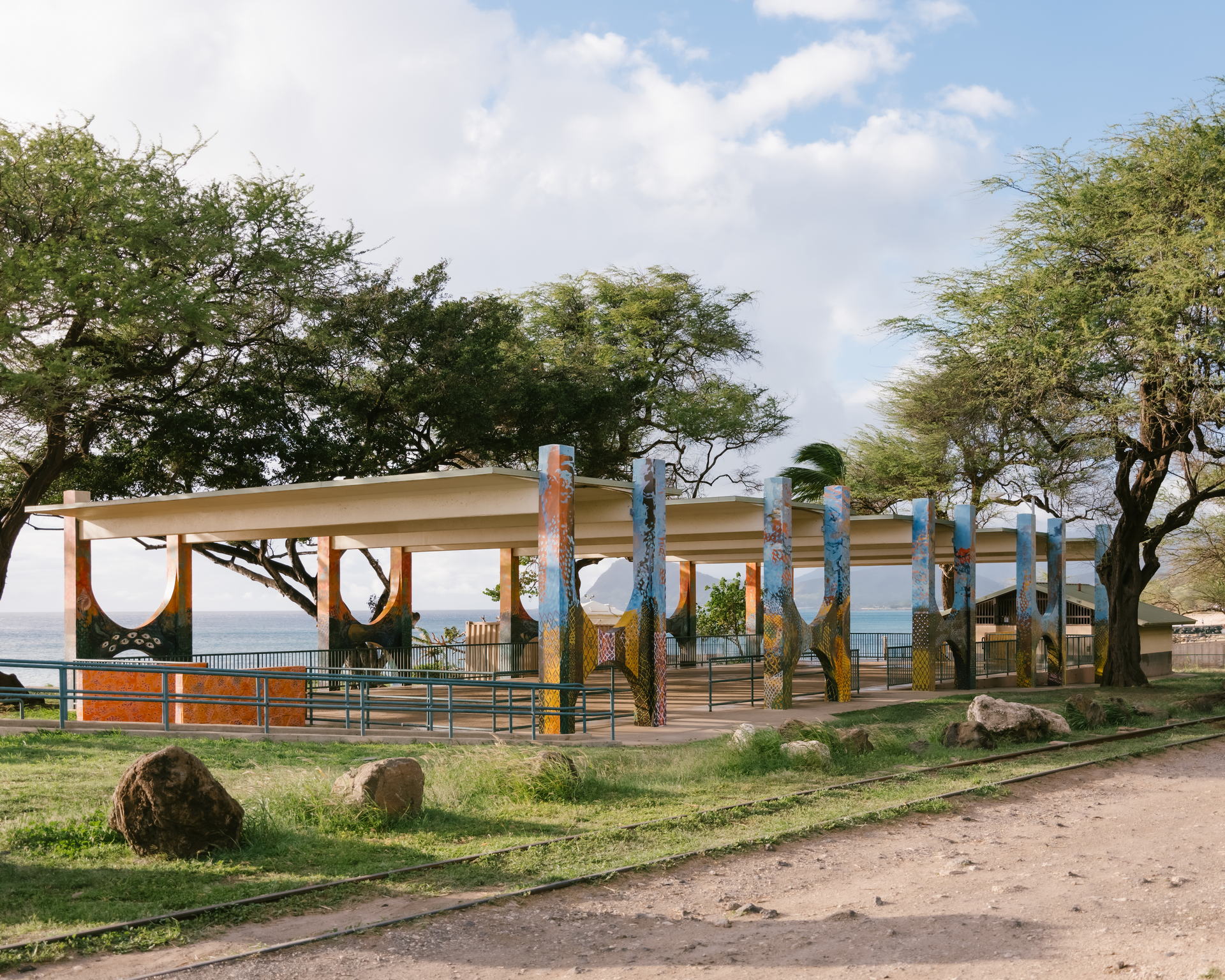
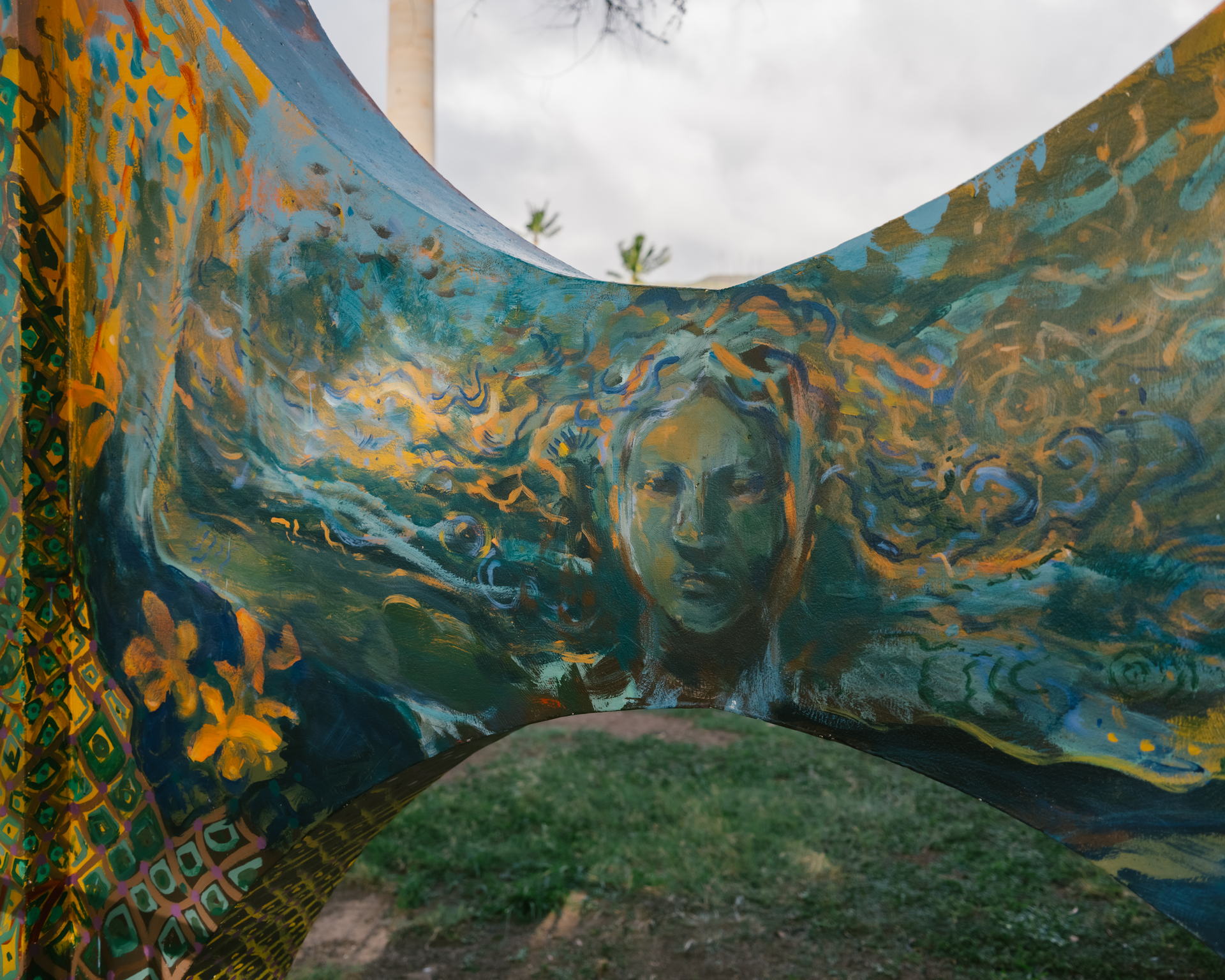
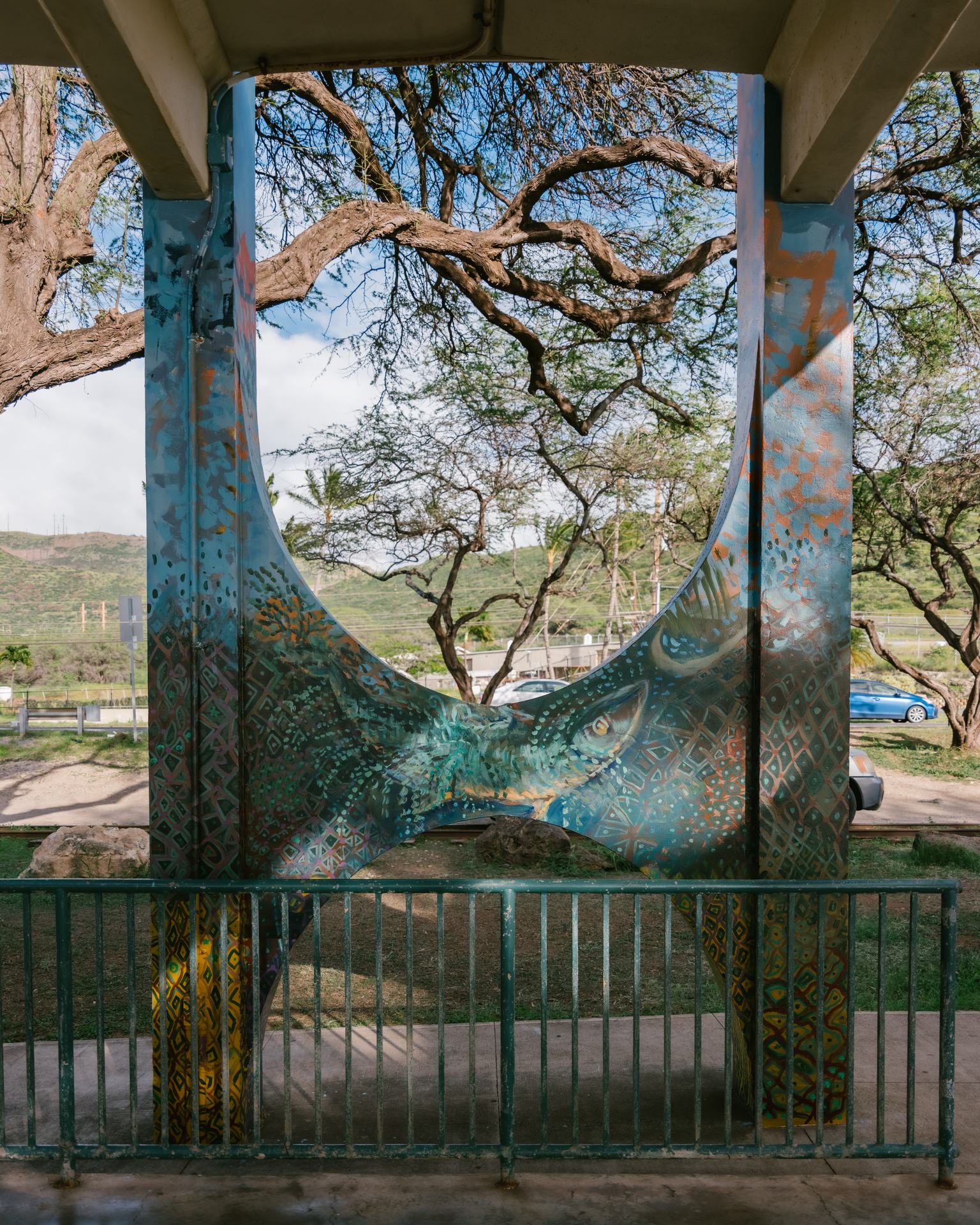
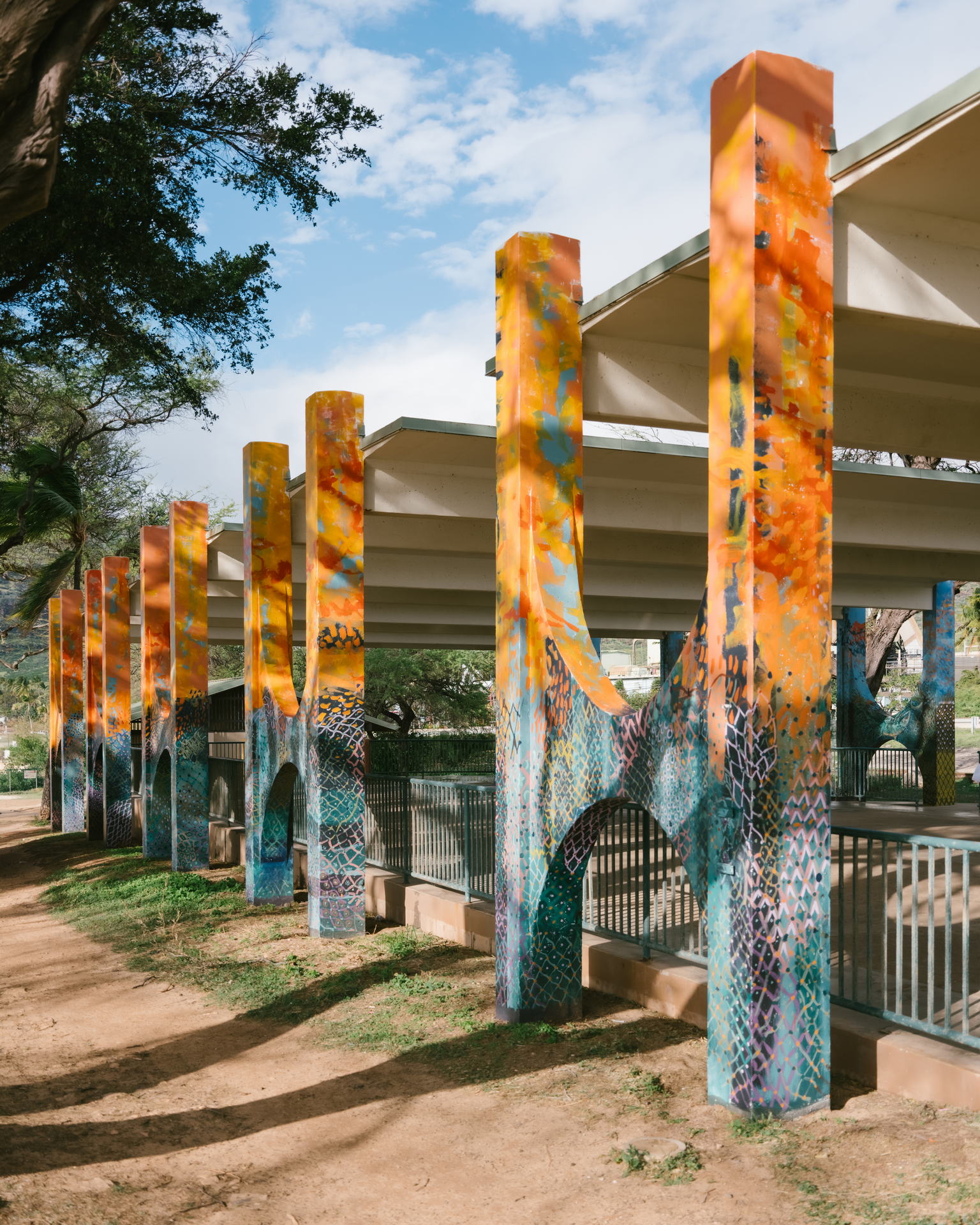
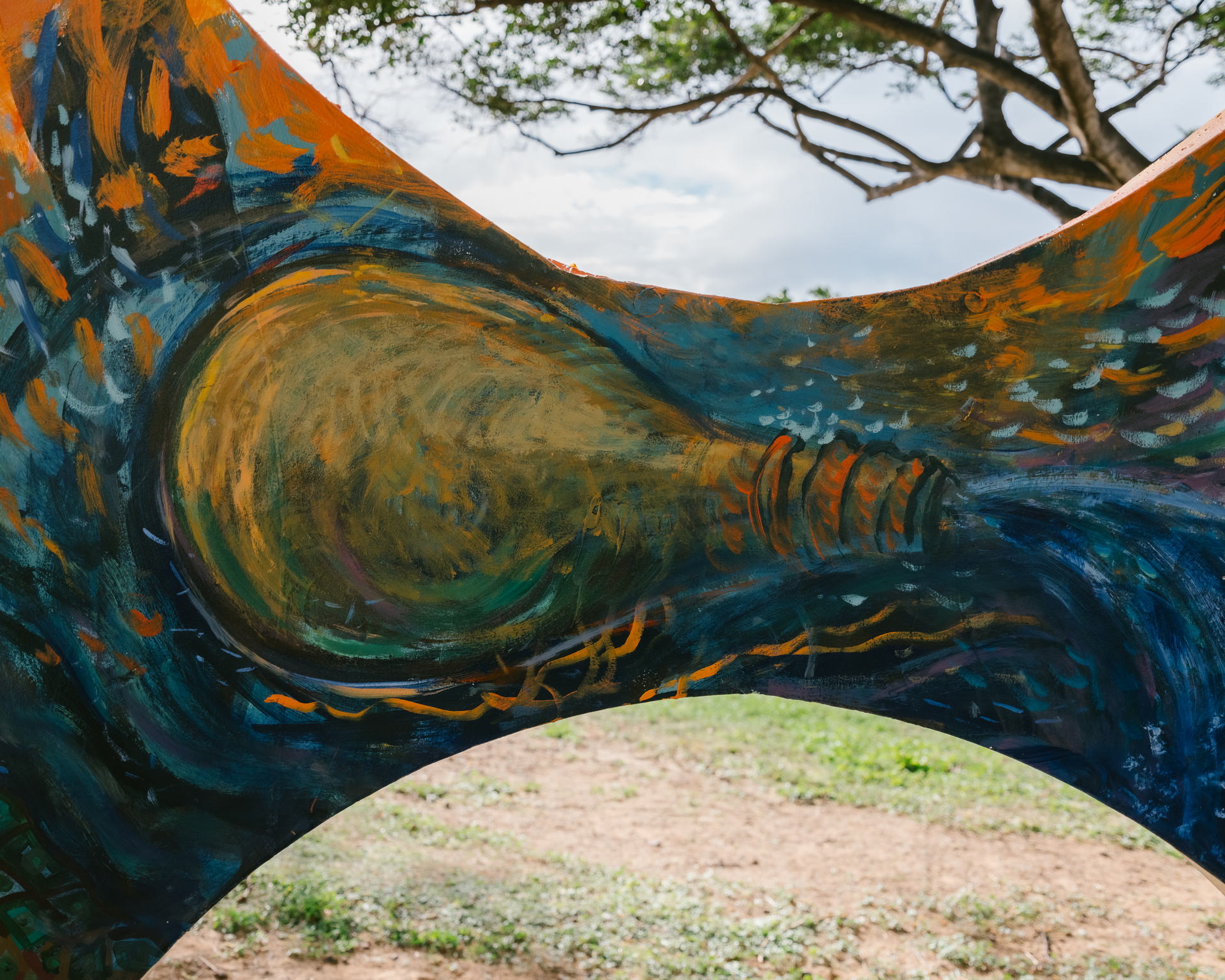
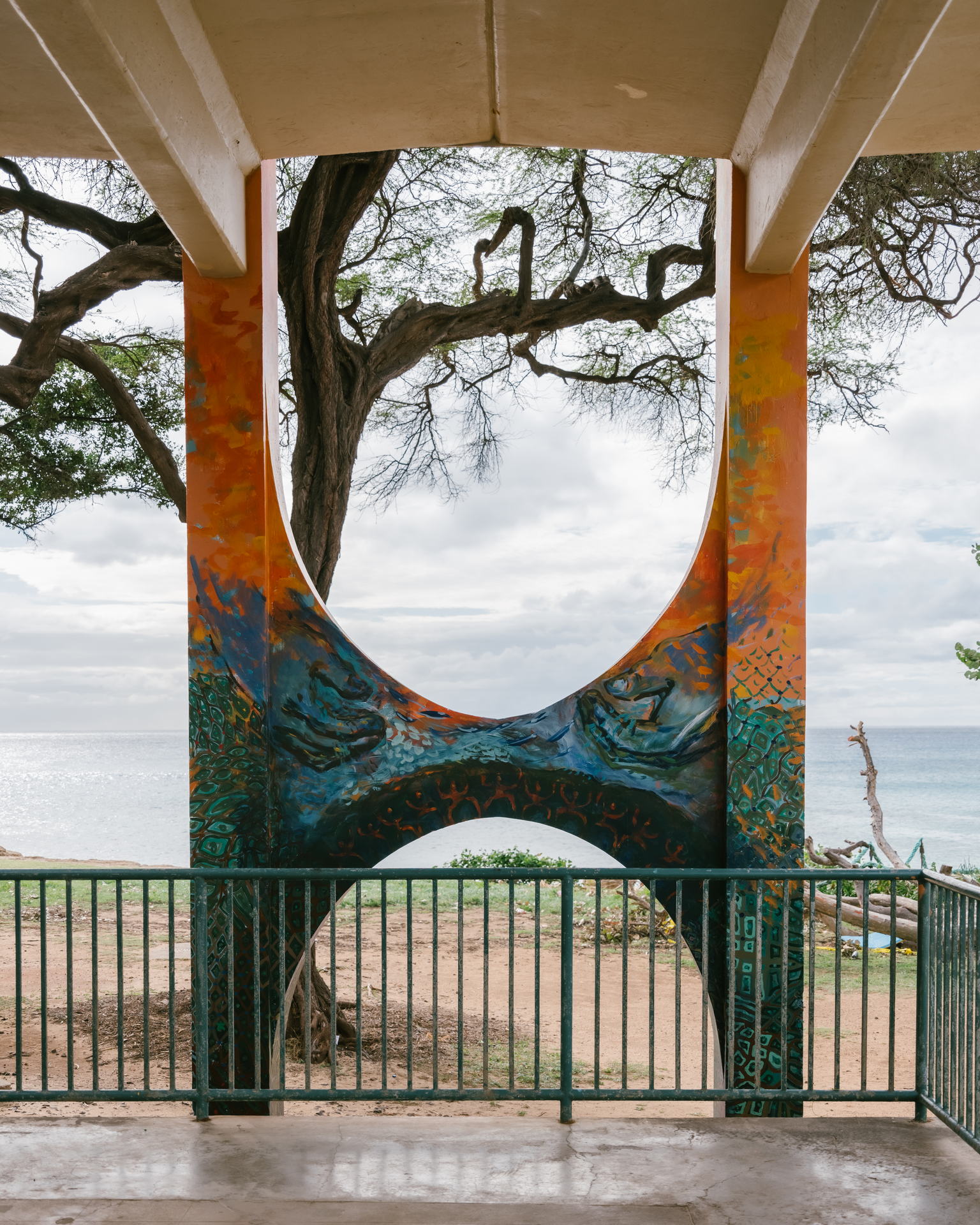
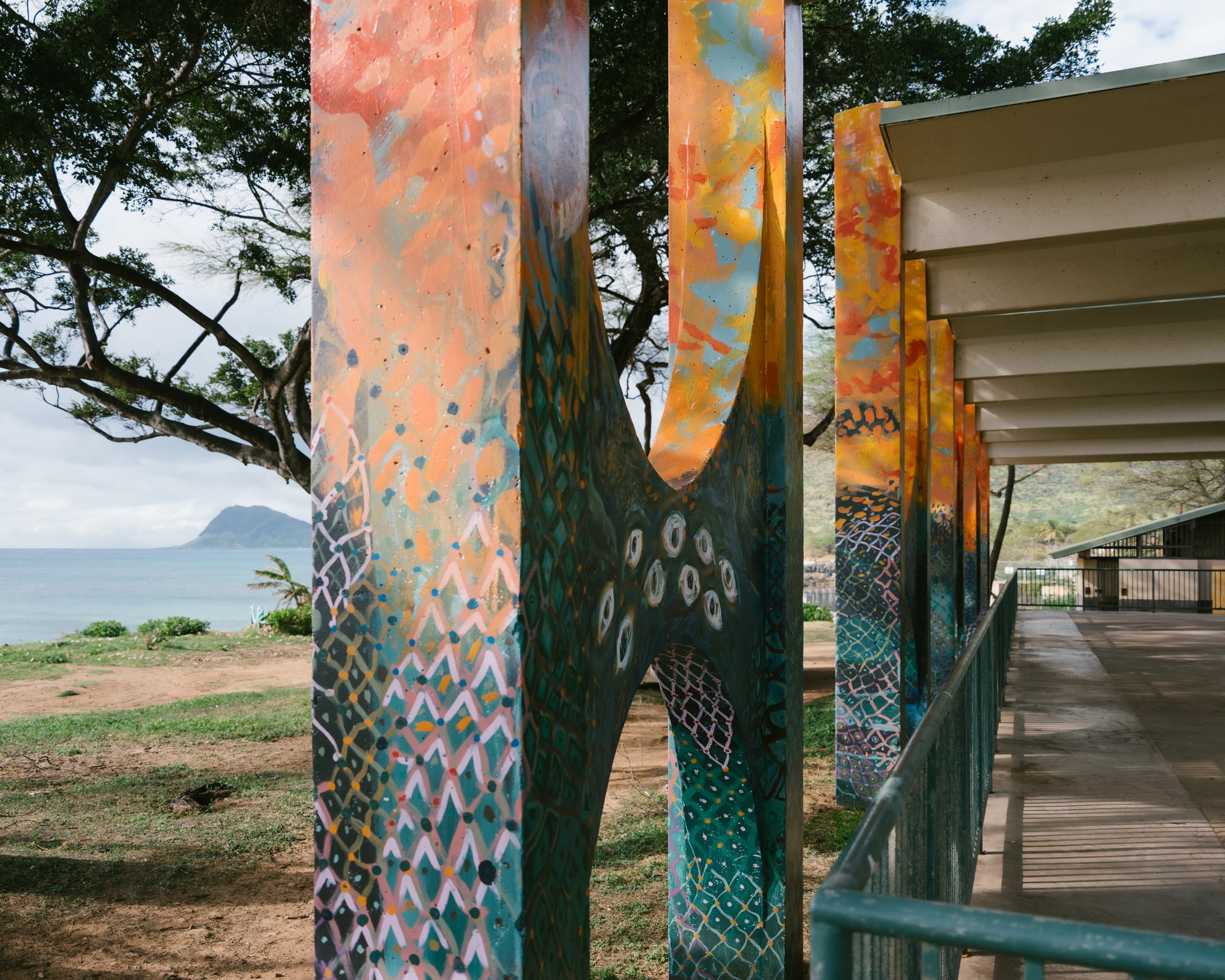
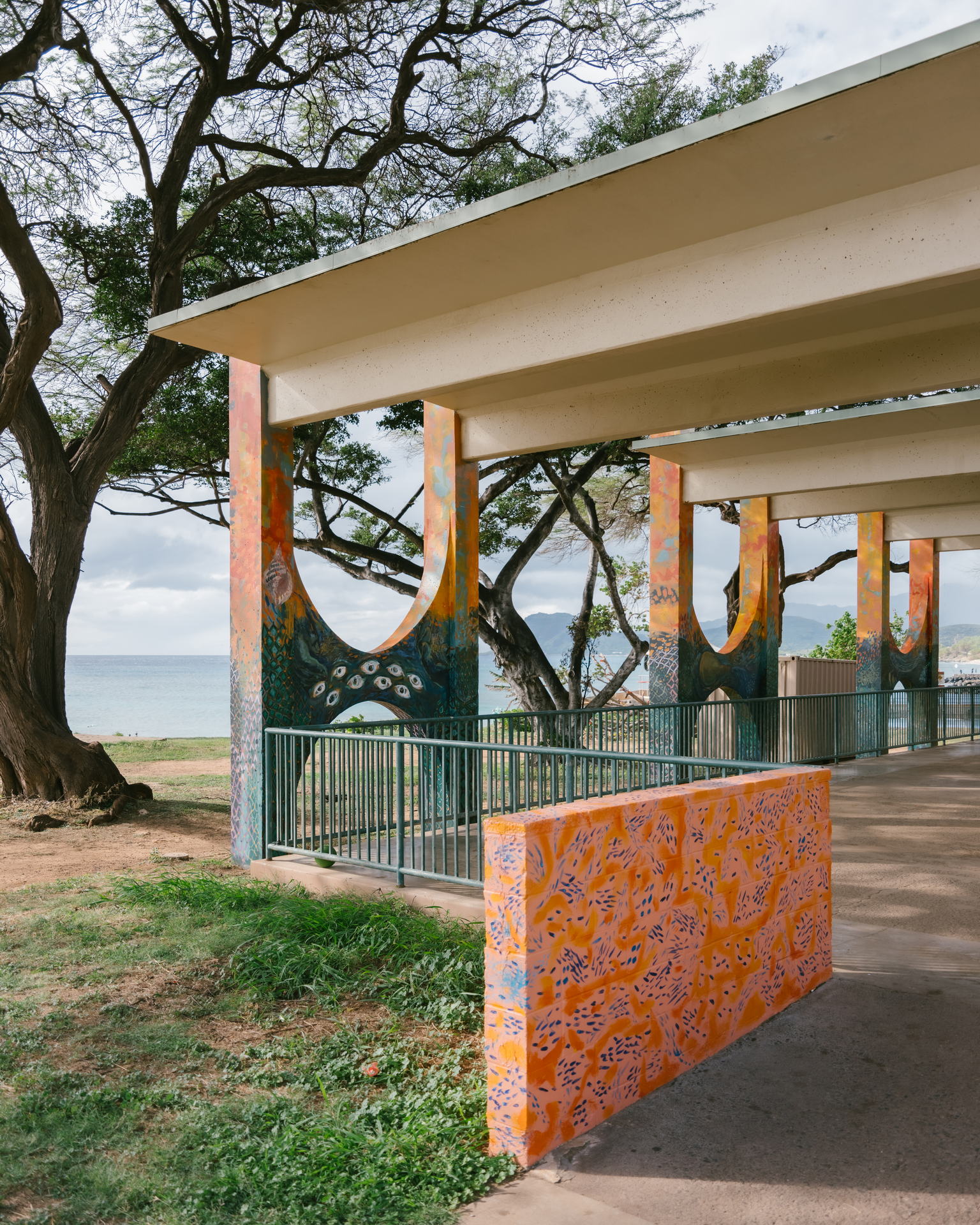
This mural reanimates the mo‘olelo of five adjacent ‘ili (land sections) within the Honouliuli ahupua‘a. Depicted across five sets of pillars, imagery of each ‘ili draws on the dualism of uka (upland) and kai (sea) to breathe life back into a space that was transformed after the land & coastal erasure activities of the Hawaiian Electric Company (HECO), Ko Olina Resort, and the Waimanalo Landfill. Let us recognize and celebrate our wahi kupuna.
Kahe has long been a place of abundant wai (water). Flowing at the outlet of Keone‘ō‘io; feeding the loko pu‘uone of Waimānalo, and sustaining the nutrient-rich waters of the fishery of Hāni‘o down to Kalaeloa, the blessing of wai has long been a source of waiwai (wealth). By knowing and sharing these stories, we help reconnect Kahe to ongoing efforts to restore abundance through nā mea waiwai (all that sustains our well-being) from both land and sea.

Mo‘olelo
Ka Pili o Kahe
Kaʻiminaʻauao Kahikina
Ka Pili o Kahe by Kaʻiminaʻauao Kahikina, explores the cultural history, place names, and moʻolelo of Kahe, Honouliuli, and the broader ʻEwa region. It highlights significant places such as Piliokahe, Makaiwa Gulch, Waimānalo, Keoneōʻio, and Limaloa, while tracing their connections to traditional boundaries, freshwater resources, aliʻi, and ancestral stories. Central to the document is the moʻolelo of Kaehuikimanoopuuloa and Kaʻahupahau, revealing the deep relationships between people, place, genealogy, and the revered shark deities of Puʻuloa and ʻEwa.
Ka Pili o Kahe
Explore the full research and moʻolelo behind Kahe, Honouliuli, and ʻEwa, including the significant places, genealogies, and cultural relationships that have shaped this ʻāina across generations.
Artists in Conversation: Meleanna Aluli Meyer and Solomon Enos on Nā ‘Ili o Kahe
Artists in Conversation: Meleanna Aluli Meyer and Solomon Enos on Nā ‘Ili o Kahe
Meleanna Aluli Meyer:
[foreign language] I am a child of this place, but I was born and raised in Kailua. So that is a huge stretch for me being on this beloved west coast, Komohana, because I was born and raised Kahikina, Kailua. And my practice is to appreciate where I am, to observe deeply. My practice is to create beauty that ties to spirit. My practice is to wrestle with difficult issues in ways that help others to contemplate different ways of viewing things. My practice is many things.
Solomon Robert Nui Enos:
Aloha. [foreign language] Yeah. My name is Solomon Robert Nui Enos. I am the current artist in residence at the Hawaii State Art Museum, Capital Modern. I was born in Honolulu because I was just where the hospital was. But the sands of my birth are in Mākaha. And I am in Nu’uanu today because that’s where all the troublemaking needs to happen the most. That’s the critical mass of where there’s a lack of real troublemaking in Honolulu currently.
As an artist, I simply, if I could peel away all the layers of the onion, peel away all the layers I would get down to the core is that as descendants of navigators, we knew these islands existed before we got here. And simply put, as an artist, we are also kind of like navigators. I believe there is an exponentially more just, more equitable, a kinder world than we currently have today. The va’a of the future is not necessarily to take us from island to island, but rather to take us from states of being to other states of being. And the va’a are these large ‘umeke kind of shapes that people can sit inside.
Meleanna Aluli Meyer:
We approached it, I did, in terms of just walaʻau with this incredible colleague and friend with humility in a way because it was a big project and I didn’t quite grasp how we were going to do it successfully. And I didn’t know enough about this Kahe Point to know that we didn’t start correctly. And it’s really important for artists and for you all to know is that you’re not looking for perfection, you’re looking for answers. You’re looking for ways to approach problems so that you can deal with them successfully. So in terms of approaching, I thought, well, we’ll handle the whole coast and it’ll be a point of interest or entry into Kahe Point as that beginning. So we were going to include everything along the coast and try to do it all.
And then, we were introduced by folks from the community who really helped straighten us out, at least me, I will tell you that because I wasn’t ma’a or akamai to this place, its significance and the memory of where we are. We’re at a very specific ‘ili in a very specific ahupua’a of Honouliuli. And I thought we were in Waiʻanae. So part of this whole process of getting involved and understanding beginnings is to be able to say, what do I need to know about a place and what are its connections to the people here. And to me, because this is also, [foreign language] so it isn’t as if you’re born in one area and you stay in that area. This is my beloved west side where the sun goes down in the afternoon.
So the project has really evolved from a place of not unfamiliarity, but not knowing enough. And so for me to learn about Kahe Point has been really extraordinary. And you being from here, young man, what’s your take on all of this that your father has helped us understand and Ulukoa and Kimo? These guys really helped us, didn’t they?
Solomon Robert Nui Enos:
Yeah. I, probably at this phase, because we could talk towards all the different folks from the community who all contributed to the navigation of this piece into existence, I would definitely at this time want to evoke the name of Kumu, Kumu Ulukoa, who is a kumu hula of a Kaiāulu in Honokai Hale here and has done just amazing advocacy along the coastline to talk about the health and the wellbeing of the entire ahupua’a of Honouliulili. And then a cross-section that with having grown up here on the coast driving by Kahe Point all the time and not really feeling a connection to it because I didn’t really understand it, it was always a place we passed through, kind of like a gateway where we never really spent a lot of time trying to really understanding what this place was actually about.
And part of it is when you get here, you realize that there isn’t much of a valley. It’s a very shallow, it’s like an alcove because around the corner because you have ʻUlu o Lele, which is the largest caldera in the States, so much of our attention and our view plane. And as we look from this point here, we basically can see right across to Mākaha. So we see the entire coast up until about two-thirds, almost like at least easily half of the ahupua’a of the Waiʻanae moku, you could see from right over here. So my view plane has always been this connection.
Now, however, we had a chance to really bring forward and recognize, much like blood returning to fingers that have been numb for a long time, this whole project has been kind of like pins and needles. It’s a slightly awkward kind of a thing, but now that the blood has returned into this place again, when we showed up this morning, lots of people are loving the space that we’re in.
Meleanna Aluli Meyer:
Get into.
Solomon Robert Nui Enos:
We didn’t even get into the space, a lot of people were really loving these pieces and we have heard some really positive feedback about the work that was here. So overall, the approach was really something that we have thousands of hours between us of, well, our art and our own practice and as a conservative estimate, hundreds and hundreds of hours of community participation. If we could not have gotten community involved in this project, this project wouldn’t-
Meleanna Aluli Meyer:
Have been.
Solomon Robert Nui Enos:
… Have been, I was going to try to end it on wouldn’t.
Meleanna Aluli Meyer:
Yeah, wouldn’t. I like that. That works.
Solomon Robert Nui Enos:
It wouldn’t. It just would not. Immediately I think when we enter, art is solving problems, and when we entered into this space, it was a design challenge. A beautifully laid out meal is a challenge. It’s like, this is my task is to eat this delicious meal. Where do we cut? We take a little bit of this first, then we put it on top of that and then we nibble it. And so the way we, we literally ate this project insomuch as that we digested the whole process. We saw that there are five major structures held up by four bisected pillars, four pillars.
Meleanna Aluli Meyer:
Sets of-
Solomon Robert Nui Enos:
… sets of, four sets of pillars. And so when we looked at the overall design, that was kind of like a trellis for a garden. It’s a structure. It was like, “Hmm, okay, well, we have five.” If we then in conversations, I think Ulukoa probably was the one that really put the ume in the musubi with this one over in here. He put in that that bit of flavor that gave context to the rice and the nori, like it was right in there. And that was the five ‘ili that spans this beach, that spans this location. And it’s the five westernmost, northwestern-most ‘ili of the Honouliuli ahupua’a. And by evoking their names, we were bringing back the blood to these places. And I have those five names for you when you’re ready.
One way to think about ahupua’a is a land division in which within this area of land, the people who live there have all the things they need. And so that’s one way of thinking about an ahupua’a. I know that there are other folks who have other definitions of what that is, but I’m going to just leave that there for now. The ‘ili are subdivisions of that ahupua’a. So if an ahupua’a is a body, one way to think about it is like the ‘ili are the different parts of that body. Or if it were a set of organs, if ahupua’a was the entire, all the things that we hold within us, the ‘ili would be the organs of that.
Meleanna Aluli Meyer:
And or if you had a hand, these are fingers, the little spot.
Solomon Robert Nui Enos:
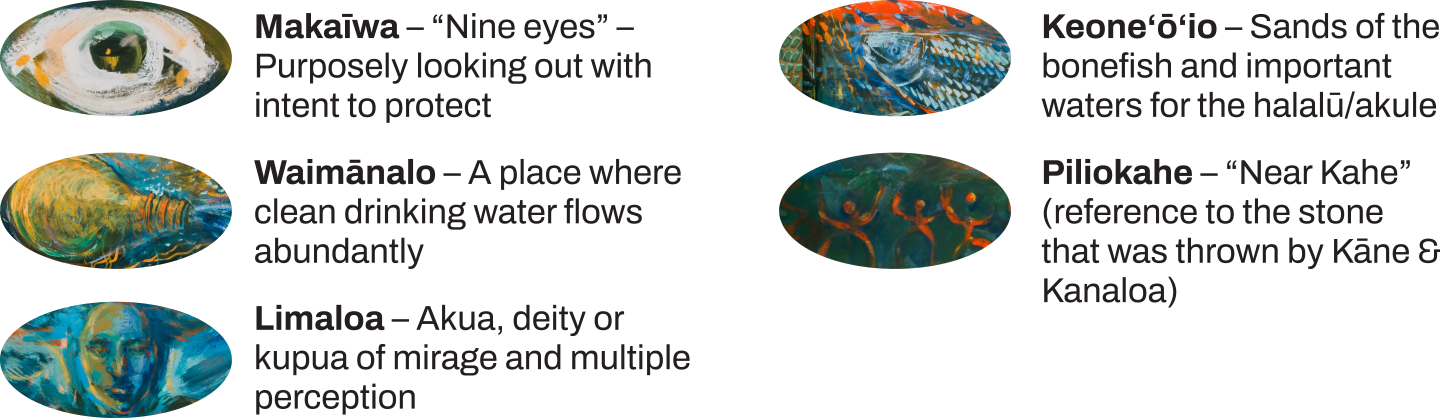
We will never run out of analogies when we’re talking about how we think about the divisions between the land and how we engage with it. And yeah, we’re sitting on the northwest five ‘ili. From the northwest, going down to the southeast-ish direction, we start with Piliokahe. So Piliokahe is the area on the far end of this beach here and it’s at the point where the Honouliuli ahupua’a adjoins the Waiʻanae or the ʻUlu o Lele ahupua’a. And where the Ewa, thinking it more broadly, the Ewa moku meets the Waiʻanae moku. So it’s Piliokahe. So Pili is the connection point within kahe. And there’s a moʻolelo there about a large pōhaku that was thrown, a large boulder that was thrown. And kokahi estimate it’s gone astray.
And there’s also really evidence of petroglyphs design and those are some of the things that we featured in the actual art installation that we have. There are large shadow shapes that sit behind a lot of the details you see in the mural and each one of those are reflections of the five ‘ili. The second ‘ili closer, moving again southeast, moving down the chain, we have Limaloa. And this next ‘ili, Limaloa, is dedicated to Akua, a deity that is related to mirage and illusions. And he’s a deity who came from Manakawai. Not enough time to go into what all of this might mean because I think what we’re talking about is I’m defining doors. I’m not defining what’s really behind the door, I’m just defining doors. And I think that’s a wonderful place to begin. It’s a corridor of doorways and we invite people to explore it further.
The middle structure is dedicated to Keone’ele so this is the bonefish. The ʻōʻio is the bonefish and it’s the sands of the bonefish. There’s tons of other layers of Kona that are woven into this work, which is why we’re thrilled that we do have further documentation that folks like kumu Ulukoa and some of the other folks that we’ve worked with will be able to expand on a lot of these things.
Then the next structure over is the Waimānalo. And Waimānalo is, it’s in reference to two important things and that is it is examples of where freshwater would run down and there’d be abundance of freshwater that would feed all the limuda, the-
Meleanna Aluli Meyer:
Along the.
Solomon Robert Nui Enos:
… vasts along the coast of Honouliuli. So it’s such a critical location. But also my understanding was in the design, we have these large, long shapes, long strokes of energy that are behind some of the work that was built over it. And my understanding is that’s also the area that when you wanted to begin your route up along the Akua ʻōkala, the spine of the sun, which is the ridge line of the Ka’ala Mountain Range, that’s where you entered into that ridge line access. So there are a lot of trails in the area of Waimānalo. And the Makaiwa, the nine eyes. And in this one we’re talking about there’s a very important vantage point that sits right at the end in our fifth ‘ili before we continue on to the rest of the ‘ili of the Honouliuli ahupua’a. And in this one area, it’s akin to all the Mākaha associations that we have as a way of vision and view planes akin to, I believe it’s in the same spirit of Makakilo. So it’s the Mākaha we don’t talk about enough and now we will.
Meleanna Aluli Meyer:
And what’s important too for us with this Wahi Pana project is it’s an opportunity for others like myself, other kamaʻāina, others who also visit to learn more about where they are and to appreciate the depth and the richness and the history, not just the beauty. I mean it’s exquisite. We’re in the most beautiful place in the world as far as we’re concerned, but it’s really what is behind the name, why the behind the name, and how it makes a difference to those of us who live here. And to be able to interface with this notion of Wahi Pana, which is a storied place, is really powerful because when we stop to take the time, I think that’s what is remarkable about this project because it’s allowed us also to do the same thing, to sort of really not only digest, but to work in community to better understand and to help not only them, but the rest of us who transit and travel through different parts of Oahu to really understand and appreciate these storied places.
So it’s just been a wonderful opportunity and exposure too to be able to understand this kind of stuff. So we’re very happy. Describing these structures is like pretty ambitious because they are meant as stanchions to describe or encompass a space. And before they had that utilitarian feeling and now they have the invitation as ‘upena holding, as nets holding this space and David Hockney, because I love Hockney’s work, and it was inspired really by his handling of space and his ability to create a multiplicity of planes. So for this piece, we had interior space, exterior space. We had height that was really an issue that we were able to deal with. But most of all, as you’re incorporating stories, what we want to do also is to keep a continuity to the look. So these ‘upena, these nets were protecting on the outside. And also in terms of community, we really had to pick forms and opportunities for folks to work so that they could feel successful in their work.
And it’s very difficult to do that, but thinking on your toes, you’re going to come up with very creative ways to be inclusive. And to be, for us, this was very much a puzzle. It was a puzzle to figure out, but it actually is successful because of the abstract nature of how we approach the project. And because of the complexity, we were able to sort of broaden the scope of what we were trying to do in terms of technique as well as story. For lack of a better word, we could get into the minutia, but we’ll wait for that.
Solomon Robert Nui Enos:
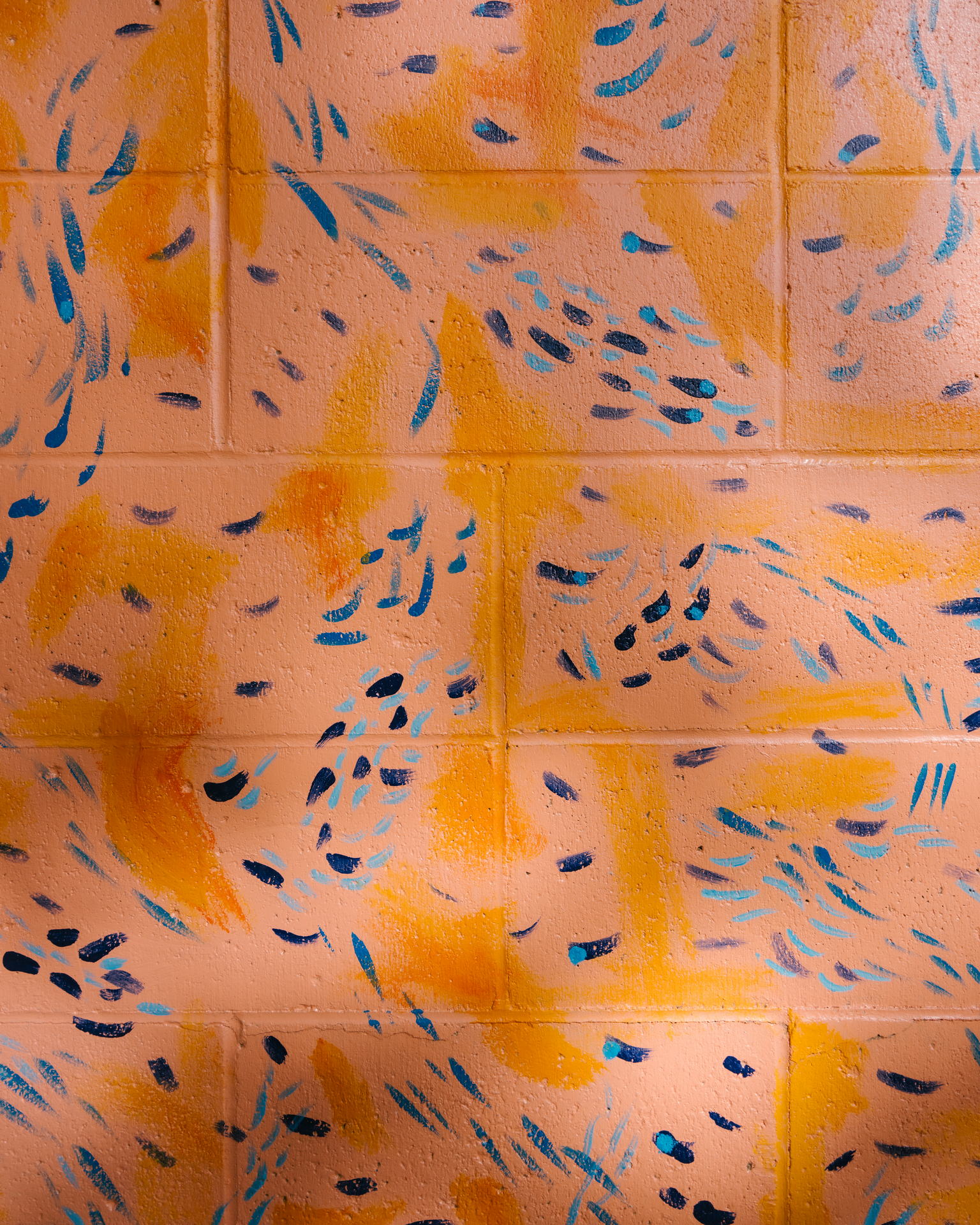
We mentioned there were five different ‘ili. Each of the five structures, each were dedicated to the five different ‘ili. So there are some visual centerpieces and the centerpieces, they all sit on the inside of the structure. So when you’re on the inside, you see these centerpieces and there are 10 centerpieces organized into five groupings, as I mentioned before. Taking a deficiency and turning into an asset. Because we did not want and we could not have community on ladders, myself and a small team, we all had rollers and we decided to say, we’re going to channel a little bit of a, ooh, I don’t know, somewhere between Rothko and Lagunero. We’re just going to roll these impressionistic skyscapes so that when we work our way down the pillars and you see these ‘upena that the community helped to make, they seem to dissipate into sky or sky is coalescing into ‘upena or both. Why not both?
Meleanna Aluli Meyer:
Yeah.
Solomon Robert Nui Enos:
Community participation was critical for this whole project, everyone, once folks learned that we were creating a visual motif and that we would want to stay unified with this motif by creating ‘upena forms, ‘upenas that hold, the ‘upena that carries, the ‘upena that connects like a network, all the different connotations of what a net is. The last little critical note was that we had a pallet that we were working with. So we did give people various pallets to work from, but then we did invite community to rotate, so that folks could bring their own particular style of how to make these forms, but did not just stay in one area populating one area with their own idiosyncratic style. We moved everybody. We rotated everyone, much like the water that’s constantly rotating and moving across the coastline, keeping things fresh all.
Meleanna Aluli Meyer:
Keeping things fresh. We also do this as a professional practice. When we do our large murals, the seven of us plus alakaʻi and other ho’omana, we move everywhere. So the project itself comes up together and that’s really critical. I don’t see that done by anyone enough because it’s not something that community is given in terms of confidence to to move, to be able to add. And granted, we had the last few days to finish, which is really important for us to add that our own solid coming refinements and things. But if you’re going to do community work, you have to have work that’s meaningful.
Solomon Robert Nui Enos:
I feel like I have part of my nervous system extending into this land here where once it was just numb. Plus I just did it now, I never really had a feeling for this place and it was just because we drove by it all the time for years and never slowed down. And now, there is a sense of kuleana of this. And honestly, I think there is just a tiny little segue into a very small idea that there may be opportunities in the past where we do invite community to come back. And it’s been several months now. There hasn’t been any damage to the artwork. I can understand why sculpture is often a preference because you can clean a sculpture. It’s much more difficult to clean a mural if it does get damaged. But we went for it and people have hānai’d it.
In the not too distant future though, I will be sure to be in partnership with the city when we do this, we might invite community to come back and maybe we will have some ladders. We will take care of the liability on our own. But maybe we’ll extend the artwork. We’ll continue to build this ʻupena. This might be a kind of work in progress that we continue to add to. And as long as we keep all of the intentions behind the work, it reminds me that our heiau were not designed to last. They were designed to be upkept because it’s in the upkeeping that we continue to mālama and continue to put breath into something. We don’t lock things together with concrete, we lock things together with community.
Meleanna Aluli Meyer:
And they have to be used. So there’s that form and function and the essence of what each of these works that we’ve done together over the years is really essential because the manaʻo and the mana work is as critical as anything else. So for me, I’ve been changed by this work because again, the form is very radically different from anything we’ve worked on before. It’s dimensional and we had to consider it inside, outside, upside, downside to this. But most importantly, just being here in this beautiful Wahi Pana as in Honouliuli and Waiʻanae, it’s been a real privilege to be at this ocean, to be on the shore, to dip my toes into the water and to just be here at different parts of the day and just to enjoy a space that is now welcoming in a different way. Its animated is what it is.
Solomon Robert Nui Enos:
Yes.
Meleanna Aluli Meyer:
We’re really trying to take back in ways that are productive and resourceful and are positive offerings for community because things do not need to be defaced, they do not need to be destroyed. And so we’re actually, this is part of a movement also to just improve the public’s understanding of art. It’s really important, I think it is.
Solomon Robert Nui Enos:
Absolutely. Yeah. Absolutely. So much emphasis on the idea of [inaudible 00:24:08], commons were magnitudes larger than what we consider commons today. Private space, there were places for sure, but nothing like what we have today. We need to protect our commons and we need to grow them.
Meleanna Aluli Meyer:
And you know what, all of this diversion in terms of sound and cacophony of things, it’s really perfect because this is Kahe Point and it is used by so many different groups. And personally, that’s part of the color of the place. And I think we brought a lot of color to this space, deeply considered, from the sunset idea to the early morning sunrise over the ridges, what things were represented in terms of how kanaka were represented in the murals as well. And the fish and the objects, the iconography of the inside of the mural, being very welcoming, especially to bring the keiki into this space to help them understand what it feels like to mālama as well. I mean, that to me is the most important that now the space actually gets to be animated in a way where people might go, “Okay, we get [inaudible 00:25:35] kuleana to this space.” And I think that’s really important and that’s why this larger project has really given the community a great deal of not ownership, but responsibility to these places. I think that’s been a blast.
Solomon Robert Nui Enos:
Absolutely. And if I can create a shameless plug for the idea that painted exterior public murals are both fragile and what makes it so vital is because they’re fragile. Like I said, it’s very easy to go and just deface a wall and destroy it. But I’m excited about the potential future where we could have more projects where we take particularly things like paint that could be recycled, paint that would otherwise be thrown away, materials that are very, very low overhead and where it truly is sweat equity because we say we’re going to invite tons of community to help us to paint.
I see potential canvases everywhere for semi-permanent art installations where we are able… And my vision in the future hopefully, or our vision, and I think what we’re trying to do is reach more community as far as this kind of engagement shows to show that this truly is a valid way to paint on the walls like we’ve been doing for hundreds of thousands of years, I mean, inside caves and now we’re outside of caves, from caves to credit cards and other horrible things. And that I would love to invite the kids who would normally get into trouble for doing.
Meleanna Aluli Meyer:
Those are our favorites because they’re the talent.
Solomon Robert Nui Enos:
Let’s do this together. Instead of making noise by yourself, let’s sing together. Join the choir. There will be rules, but there will also be recognition and there’ll be community, which is what so many young folks are looking for.
Meleanna Aluli Meyer:
They are. They really are.
Solomon Robert Nui Enos:
That’s being like, “I’m alive. See me, see me. I don’t care if I get into trouble for doing it. I just want people to know that I exist.” Artists, we get spoiled because we get a lot of attention. People are constantly interviewing us. I don’t know why they interview me. But we get all that attention, our cup flows over. So how can we help to redirect attention to communities, to individuals who would really benefit from the kind of ego boost, you know what I mean? From the kind of recognition that getting your name or getting your artwork on a wall can provide.
Meleanna Aluli Meyer:
And by the way, we plan on doing workshops in community, furthering community in schools. So this is also part of my commitment as an arts educator. And I think we all bring different skillsets into this conversation and that’s what also makes for a very rich tableau of opportunity. I’m so excited because we’re not done with this project yet and I think that’s the exciting part. We’re still being very much participants of the larger story, the Maʻiola of this place. So just mahalo for that.
Solomon Robert Nui Enos:
We live on canvases.
Meleanna Aluli Meyer:
Or in ‘umeke and 3D kinds of all sorts of-
Solomon Robert Nui Enos:
We live on the art.
Meleanna Aluli Meyer:
Mahalo, Kamuela.
Solomon Robert Nui Enos:
Huge shout-out to all the hands, the Lao Lima, the hands from the coast, the hands from both. We had representation from both the Ewa moku and the Waiʻanae moku. This was a meeting place for both moku to be pili together again.
Meleanna Aluli Meyer:
Not to mention the Mayor’s Office on Culture and Art.
Solomon Robert Nui Enos:
Oh yeah.
Meleanna Aluli Meyer:
And small extraordinary details like that. And for that matter, Bloomberg, thank you for the faith that you’ve also given and the opportunity for us to tell our stories because it’s really important as you see. And mahalo ke akua as we will continue on no matter. So blessings.
Solomon Robert Nui Enos:
Wahi pana i ka āpau.
Meleanna Aluli Meyer:
All right. [foreign language], just our storied places everywhere. They’ll continue, our stories. Yeah.
The Artist(s)

Meleanna Aluli Meyer
Meleanna Aluli Meyer is a visual poet — alchemist of light and moving image, translator of ʻike Hawaiʻi — native wisdom through kaona, metaphor. Engaging audiences and viewers on canvas, in film, and the written word, Aluli Meyer interfaces with the world through a Hawaiian lens, which allows her to share authentically, from a Kanaka, Hawaiian, perspective. As a kamaʻāina, child of the land, Aluli Meyer has cultivated a deep appreciation and connection to the sands of Kailua, her one hānau, birthplace, in the ahupua‘a of Koʻolaupoko, Oʻahu, Hawaiʻi.
As a Salzburg, an EWC and APAWLI fellow, those deeply engaging cross-cultural experiences have gifted her with rare insights about the world. Aluli Meyer is a seeker, with a never-ending curiosity about complex, intractable issues that provide a rich palette from which to draw, paint, ideate, and realize her work. Hers is an exploration of articulating personal and collective connections to people and beliefs, through line, color, form, and essence. While pursuing a design-photography degree at Stanford University (ʻ78); Meyer spent a year overseas, living in both Italy and France, as a student of history, linguistics, and design. As an award winning artist and educator she sees her work as a springboard for deeper conversations, and further, for reconciliation and healing.
Aluli Meyer builds her work, layer by layer, often digitally, pressing ideas that translate into resonant and vibrant images and films that allow others access into a Hawaiian worldview that is authentic and deep.

Solomon Enos
Solomon Robert Nui Enos is a Native Hawaiian artist, illustrator, and visionary. Born and raised in Makaha Valley (O‘ahu, Hawai‘i), Solomon hails from the well-known Enos ‘ohana. Solomon has been making art for more than 30 years and he is adept at artistic expression in a wide variety of media including oil paintings, book illustrations, murals, and game design. A self-described “Possibilist”, Solomon’s art expresses an informed aspirational vision of the world at its best via contemporary and traditional art that leans towards Sci-Fi and Fantasy. His work touches on themes like collective-consciousness, ancestry and identity, our relationship with our planet, and all through the lens of his experience as a person indigenous to Hawai‘i.
Photos
Photos: Lila Lee